Franklin, Tennessee and Starbucks Coffee Cup Quote #141

The Way I See it #141
I used to feel so alone in the city. All those gazillions of people and then me, on the outside. Because how do you meet a new person? I was very stumped by this for many years. And then I realized, you just say, “Hi.” They may ignore you. Or you may marry them. And that possibility is worth that one word
— Augusten Burroughs, author of Running with Scissors
I read this quote, not a new one to me, this morning sitting in a coffee shop in Franklin, TN. The whole vibe of this Starbucks is different than ours in Palm Beach Gardens. I must say, the people watching is fabulous. In fact, the very word “vibe” isn’t out of place here. Franklin must have created that word.This place was hopping with java-loving people everywhere, meeting in groups and meeting in pairs. No one to meet? Laptop out and ready.
The funny thing about hanging out around here is the realization that everyone you sit next to might be “someone.” And I — as some of you know — am clueless.
But what if they are “someone”? If I look at them too long, or talk to them, or even — like my cup suggested — say “Hi” will they be bothered? Or will they be grateful for a bit of normal human contact in a sea of roles they play? Why does the idea of “someone” reduce me to ignoring this person or that?
No answers today, just the thought that the drive to connect with each other is in all of us, “someone” or not. If I lived here I’d have to learn how to say hi.
Connecting with people in the kingdom
David and I have had a great weekend wandering around Nashville and Franklin, Tennessee! We got off to a rough start when apparently I booked a hotel room in the middle of the only “Coffee Dead Zone” in the country! You’ve seen the Verizon ad on TV? Real zombies wander around this dead zone by the airport in Nashville. The closest Starbucks was 6 miles one direction or 5 the other. And the 6 miles Bux was inside the Grand Ole Opry itself… not conducive to running in for morning coffee! We switched hotels.
Now we are hanging out in Franklin and enjoying meeting up with great friends, old and new. At 8:30 this morning David and I went to Cross Point Community Church, where my blog friend Jenni Catron is the Executive Pastor. And oh yeah, Pete Wilson is the Pastor. And Anne Jackson is also on staff there although I’ve never met her. We had a great day of worship together, even if it was early! Pete was away this weekend, but it was a great stop even so.
After Cross Point we headed across town to The People’s Church, where we have so many friends it feels like home! Michael Neale was our worship pastor for many years at Christ Fellowship. It was amazing to worship with him again, though a little surreal to see him surrounded by peole I didn’t know! We sat with Steve and Julie Helm and their family, and were greeted at the door of the church by Nathan Oates and given a quick tour of the campus. I loved seeing what God is doing in this corner of his world. Isn’t it amazing…in this day and age you can wander nearly anywhere in the country and find friends, worship, community and mission opportunity. No excuses for not hanging out in the kingdom!

Waffle House is a cultural third place — really!


Can you tell we are traveling through the deep south? You know you’re in the south when you can write a post like this one, in which you honestly argue that Waffle House is a valid third place for a community, a place where diverse people come to connect with each other in a familiar and comfortable environment.
Nevertheless, that’s what I’m going to say today!
Our first exposure to Waffle House came from our friends, Buddy and Jody Hoffman. Buddy is the pastor of Grace Fellowship Church, whose children’s ministry is pictured in yesterday’s post. I was wrong on how many kids hang out at Grace on a Wednesday, by the way: there is an average of 1,500 from kindergarten to middle school each Wednesday. Church attendance in general runs 4-5 thousand. Now that is placing a priority on the next generation!
Buddy takes his job as a community-based, local pastor quite seriously. The time he spends in the local Waffle Houses is as important to him as the time he spends in the pulpit, and it shows. Walk into any Grayson or Snellville Waffle House with Buddy and you are greeted like royalty. Buddy has prayed with these people, teased them, loved them and confronted them. He has sat in the Waffle House in the middle of the night while wrestling with unruly sermons. And most telling of all, he has invented his own Waffle House sandwich! Ask for the Buddy sandwich for an unusual tasty treat.
Not too long ago, Buddy demonstrated to me the back and forth nature of community, the knowledge that no matter what happens in your life there are people around to back you up. Buddy had a disgruntled soul looking for a confrontation one time, and we were concerned that this person might actually come to find Buddy while he was wandering around town here or there. “Let him,” Buddy said. “These are my people. I know everyone in that Waffle House, and most of them are tough characters. He won’t get near me.” Buddy knew that his friends — friends, not helpless souls he’s “ministering” to, but friends — would have his back.
David, Kylie, Jillian and I are on a weekend trip to Nashville. Half way here we decided to stop into a Waffle House for a nice late-night breakfast. It was a different Waffle House, but there was still something similar there. People talked to each other. They made fun of the Waffle House jingle music on the juke box (even when they fed quarters in to keep it playing!). Some had teeth and some didn’t (not kidding…sorry, Tennessee!), but everyone was there just to let down and have fun.
So what do you think? Waffle House as a third place community? Buddy would say “Absolutely!”
The next generation

Grace Fellowship Church -- So that the next generation may know....
“The next big idea for the church isn’t going to come from the previous generation. Start hanging out with your student ministries and make space for them to dream.”
— Andy Stanley
Contemplating Coffee: Coffeehouse Mystery

“This isn’t your usual Jamaican Blue Mountain.”
Madame smiled. “No.” She raised an eyebrow in challenge. “Can you guess?”
For a moment, neither of us spoke as we continued to savor the flavor of this absolutely remarkable coffee, brimming with kaleidoscopic nuances of fruit. The taste was clean and sweet, yet densely rich with hints of blueberry, wine, and spice. It was bright and spirited yet at the same time deeply resonant and balanced. A coffee this complex and alive with fruit almost had to carry a very slight fermented tinge, and it did, but to care would have been like criticizing Da Vinci because he left a stray stroke of paint on the Mona Lisa’s frame.
“Is it Ehtiopian?” I asked.
“You’re guessing?”
“To be perfectly honest, the aroma is familiar only because Matt roasted a top secret batch of whatever this is after he came back from Ethiopia, but I’m still not sure what it is. Of course, your son wouldn’t tell me squat.”
“It’s Harrar. Wet-processed.”
“It can’t be.”
“Oh, but it is.”
Grown in small farms in the eastern part of Ethiopia, Harrar was one of the world’s oldest and most traditional coffees. Unlike its more elegant and high-toned wet-processed cousins in other regions of the country — Ghimbi and Yirgacheffe (a.k.a. Sidamo)– Harrar was traditionally a dry-processed coffee, meaning the coffee cherries were picked and put out in the sun to dry, fruit and all, as they had been for centuries.
Such simple dry-processing (or “natural”) methods emphasized bold fruit notes. But the fruit taste could come off as overly wild and fermented. Here, however, the wild fruit character had been tamed. The taste was more balanced, with a longer lasting body than a typical Harrar. And it was far more aromatic. The floral and fruit notes remained intact from the first sip through the last (a real trick in a dark roast). And, as th cup cooled, these flavors assembled themselves differently with each taste. It was a coplex and beautifully structured cup, a coffee for those who wished to sip rather than gulp. A coffee worthy of contemplation.”
— excerpted from Latte Trouble by Cleo Coyle
Just because once in awhile we all need to remember what fuels our passion!
Chasing away the monsters in the dark

I am not afraid.
I never have been very afraid. I grew up with a daddy who cares for me, friends who love me, and innate — if often unfounded — optimism. So fear and I usually don’t hang out much. I’ve always thought that was a good thing, a gift.
Until I read something Leroy Barber wrote in New Neighbor today. He talked about being afraid of non-existent monsters in the dark…no reason to fear them. (Yes! See? I knew there were no monsters!)
But some monsters are real. He lives with them. They are the monsters of poverty, poor education, abuse, loneliness. Like all monsters, they flee in the face of the light. But they dwell in darkness. If there are real monsters in the darkness, happily laying our heads down on the pillow and drifting off to sweet dreams is not the right response. It is not rational.
Neither is fear.
The clarion call to our generation — my generation — is to hold up the flashlight and begin to chase those monsters away. The next generation is superb at this. They are embracing justice issues right and left. If there was one thing I learned from Catalyst it is that my generation must empower the next generation to risk big, monster-chasing dreams.
This is part of Watercooler Wednesday! Gotta love Wednesdays.
Catalyst 08: The moments you live for
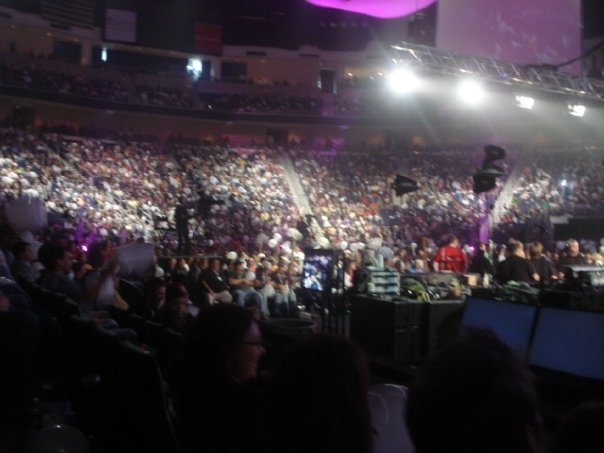
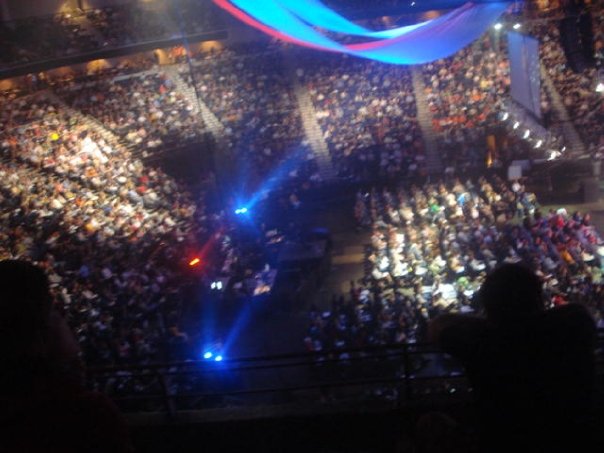
As the days have passed since Catalyst, the experience is distilling in my mind down to those moments of clarity when God steps into the picture and creates something unexpected and new. There were a few events that — for me — are weaving themselves into the takeaway message that God wants me to have from the week, so I thought I would share them with you.
- Worship. Everyone who goes to Catalyst surely comments on the worship. Steve Fee did a great job with his sessions, and I enjoyed hearing his worship sets and joining in. There is something electric in joining with thousands upon thousands. But for me, there was one set that sent the tears creeping out of the corner of my eyes: Aaron Keyes led us all in moments of unselfconscious, soul-stretching worship. During one moment he stepped back from the mic and let 12,400 people lift their voices together. It is awe-inspiring.
- Michelle. Michelle was an attractive girl who was interviewed onstage between sets. She was in her twenties (perhaps?) and was there as a grown up Compassion International child. She told her simple story of how the sponsorship through Compassion changed her life. Eventually she was sponsored through their leadership development program, as well, and was able to come to the States for an education. I am sorry that some of the details of her life are escaping me, but this grad student (who I believe is leading an arts troupe as well) sponsors three Compassion children of her own. She finances this by cutting her meal plan ticket at school from 20 meals a week to 10 meals. It was a moment of conviction and delight to see the fruit of such a simple thing as sponsoring a child.
- I cried during Steven Furtick’s message, too. The hand of God is just all over this guy, and I have hope for the next generation. I was moved to pray over his life, his family, his calling: pray that God will hold him faithful and fulfill the promise he represents. I was touched during his session when he asked the original seven families who started Elevation with him to stand and receive recognition for their faithfulness. People — community — are everything.
- The ministry tables set up outside the conference. There were amazing experiences designed for us out there. Not only could we participate in activities (“That was simple…you mean that helped?”), we could see others giving their lives away for justice and compassion.
There were other moments that I hope to process in the days to come. And there is the big question still to come for all of us who were there: “So?”
What about you all? Where did God show up for you? And what’s next?
Catalyst 08: Andy Stanley Closing Session
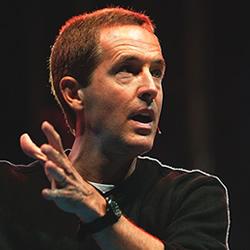
Good things come to those who wait. Or stay. Andy Stanley closed out Catalyst 08 with an amazing reflection of where he and his staff at Northpoint are in their thinking process. He gave us five quotes that he grapples with on a daily basis. The thought processes inspired by these quotes are driving the next steps of Northpoint, Buckhead etc. David and I found a lot to think about in this session, and that process has just begun. Here are the five quotes and thoughts that Andy Stanley and his staff are working through.
“To reach people no one else is reaching, we must do things no one else is doing.”
— Craig Groeschel
- There are people who will never step through the doors of our churches, no matter how cool our churches are. How will we reach them? We have to think of brand new ways of going to them, even if “traditional church people” don’t necessarily like them. In response to this quote, Northpoint has tried several projects: Buckhead Music Project, a new Northpoint Spanish service, Google Ads, Letters to the Next President. These are just the first fruits of thinking deeply about questions that bother you.
- Some people won’t donate more money for church operational costs, but they will donate money to try something radically new to reach people no one has reached.
Takeaway: Become preoccupied with who you haven’t reached as opposed to those you want to keep.
“The next generation product almost never comes from the previous generation.”
— Focus, Al Reis
- If you are 45 or older, the next great idea most likely won’t come from you. Your job, instead, is to constantly seek out the next generation and hear what they are thinking. Enable their visions to come true. Go look to the 20 year olds. If you want to find examples of radically different thinking, you should be paying attention to what your Student Ministries guys are talking about.
- Don’t do to the next generation what was done to yours. Don’t say, “We don’t do things like that.” Stop and think about what they are proposing. Give them space, money, social capital and the freedom to fail.
Takeaway: Be a student, not a critic
“What do I believe is impossible to do in my field…but if it could be done would fundamentally change my business?”
— Future Edge/The Paradigm Book, Joel Barker
- One of the stickiest problems in the previous generation of church leadership and growth was requiring a great leader to also be a great communicator. Those are two skills, and not that many people have both. What if a church leader didn’t have to beat the brunt of communicating?
- The leader/communicator issue was solved by the multi-site video venue. Now a teaching pastor can communicate well, while each campus can be led by a great leader. This fundamentally changed church growth.
- A current sticky problem to ponder: church plants need space, while some older churches are underutilizing their real estate. How do you bring those together?
Takeaway: Pay attention to people who are breaking the rules.
“If we got kicked out and the board brought in a new CEO, what would he do? Why shouldn’t we walk out the door, come back in, and do it ourselves?”
— Only the Paranoid Survive, Andy Grove
- The first thing an outsider might say about your organization is “Why in the world are you doing that?” We fall in love with the way we do things and forget to constantly reevaluate. The fact of life is that usually without pain, there is no pain. And usually that pain is financial.
- Where are we manufacturing energy? These are the programs that we do because we do. We aren’t all that excited about them, but it is what we do. We just manufacture energy. Get rid of them.
- It is painful to change. Yes, your context makes it difficult to get rid of this program, or that. It is difficult everywhere. It always hurts.
Takeaway: Acknowledge what’s not working, and own up to why you are to do anything about it.
“When your memories exceed your dreams, the end is near.”
— Michael Hammer
- We don’t want to be an expert on the previous generation!
- Celebrate the past, yes, but don’t be so celebratory that you forget the future.
- Are you willing to be invested in the future?
- Complacency breeds failure.
Takeaway: Don’t let success overshadow your vision.
Andy wrapped up by saying that in these very turbulent times it will take courageous leadership to leverage the situation in this country. Yes, people turn to God when times are difficult. Are we ready for them to do that? The fundamental problem in this country is not financial or political, it is a heart issue. It is time to step up and lead. Lead with whatever gift God has given you. Now is the time to be bold in your leadership. Be bold in your gift. Now go out and lead.
Catalyst 08: Matt Chandler

When thinking about Catalyst ahead of time, another priority speaker for me was Matt Chandler. I have heard podcast messages from him, and was anxious to see him in person. I found that watching him is an interactive adventure. He moves a lot, he is a great storyteller, and his physical mannerisms tell a large portion of his message. As a result, while I enjoyed his session immensely, my notes are pretty sparse! For instance, he led off with telling a story about a baptism at his church (The Village Church in Highland Village, TX) in which they baptized a witch, an atheist and a baptist. And yes, it sounded like the set-up to a joke. Except it wasn’t. It was a slice of life in his ministry. Chandler went on to speak about how the Baptist kid had known about Jesus, but hadn’t ever really known Jesus himself. Using I Timothy 4, he reminded us to keep watch on the way we live, because there is a way to live that exposes people to Jesus or turns them away from him.
“The good new of the gospel is that you get jesus…and he is all you need.”
