Six Ways to Connect in a Coffee Shop
I know it sounds kind of crazy, but I’ve been thinking about how to actually go about connecting with my community. Jury duty aside, there just aren’t that many times when I am interacting in the community beyond a simple trip to the grocery store or mall. I imagine that many of us are in that position, where the majority of our relationships are found in our church or (hopefully) our neighborhood. So how do you begin to take steps to be “available” when you are hanging at your favorite coffee shop? These are the things I’ve been thinking about.
- Pick one or two coffee shops to frequent. I know it sounds obvious, but honestly there are at least five Starbucks I could choose in my immediate driving distance, and I like all of them for different reasons. Lately I’ve been intentionally trying to narrow down my choices in order to build relationships with the “regulars.” My favorite “work” coffee shop is the Barnes and Noble Starbucks. I find the combination of books and coffee inspires me, and the cafe is centrally located. I see many acquaintances and friends that way. At first, if I were honest, I was annoyed at some of these interruptions, until I remembered why I was sitting there in the first place!
- Choose a provocative book and leave the dust jacket on. OK…you know I don’t mean that kind of provocative. I mean a book that can strike up a conversation all on its own. During the DaVinci Code era, I’d either bring a copy of the DaVinci code itself (yes…I read it) or one of the rebuttal books, and I got into lots of interesting conversations. My recent favorite, In A Pit with a Lion on a Snowy Day, often draws comments because of its interesting cover and unique title. By carrying that book into one of my favorite shops the other day I was able to explain its main premise to the barista. He countered with a similar verse that inspired him, and then confessed he hadn’t been in church lately. I reminded him that God really doesn’t sit there with an attendance sheet. That was it… not a huge conversation. But as I was leaving I heard another customer say, “Hey, I haven’t been to church much lately either. But I’ve started going here… you might like it…” I left before I heard the end of that conversation, but I thought how cool it was that a chain reaction was started.
- Learn people’s names. Again, this should be obvious but we often forget the small things. People’s names are important to them, so they should be important to you. This is one reason that a really good Starbucks will make an effort to learn your name and favorite drink. Return the favor. Even when in a casual conversation with another customer, people usually don’t mind being asked to give their name, and it builds a connection point faster than anything else.
- Come up for air once in awhile. If you are buried deep into your computer or book, very few people will dare to engage you in conversation. Every so often make sure you lift your head and make eye contact! A nod or a smile can start a conversation.
- Bring friends with you. Recently we met another couple and their little girl for coffee and had a great conversation going about all the ways God was working in their lives and ours. We hadn’t seen each other for awhile, and there was a lot to share. My friend is also a very outgoing personality, so our conversation was certainly heard by passersby. I noticed that there was one lady who kept trying to come near to us. She commented on the little girl, she returned twice for napkins, and she finally pulled up a chair nearby and just listened. When we engaged her in conversation directly she skittered off like a bunny rabbit, but she was warmed by the fellowship that was happening in our little circle. Not everyone will want to sit down and become your new best friend, but that doesn’t mean that you aren’t having an impact. Keep your eyes and heart open to those serendipitous moments.
- Add value to your favorite spot. Finally, be a giver and not just a taker. Lots of us sit in Starbucks and rent a table. This is a good thing, and just what they want us to do. But you can differentiate yourself if you take a few minutes to add value to the coffee shop community. I’ve done things as simple as compliment them on the community spirit the baristas create or ferry an empty cream jug back and forth over the counter for them. Remember my barista that was intrigued with In a Pit with a Lion on a Snowy Day? The next time I returned to his coffee shop I brought an extra copy of the book with me to give to him.
All these things, simple to do, make you more approachable as you sit sipping your espresso, and they help you become part of a third pace community. I would love to hear your thoughts and your experiences in this area! The more we share, the more we learn from each other. In the meantime, isn’t it great to have an excuse for one more Starbucks run?
One Way to Evaluate a Conference like Q
As most of you know, I’m still processing all that I heard at Q last week. If you missed them, you can find my Q posts further down in April. Q is an amazing conference in that it brings together people from all backgrounds, cultures and persuasions. As my husband David said several times, during the course of Q he wanted to stand up and cheer for the person on stage and at other times he wanted to stand up and throw something. That has become the definition of a worthwhile conversation to us. Why in the world would you want to pay good money to go to a conference where everyone thinks exactly the same way you do? Not a problem at Q: you name it, you can find it.
That kind of openness to dialogue, however, can lead to an opposite reaction than intended. We have the desire, ability and even responsibility to discuss what we are hearing and evaluate it. The conversations started this way are valuable. But we can’t cross the line into the territory where we are cutting down another follower of Christ simply because we don’t agree with him, or maligning the motives of a teacher or pastor simply because he seems wrong to us. We need to develop the conversation based on a mutual understanding that we all want to know God truer and deeper because of our association with each other.
I read a blog by one of my favorite preachers that captures this thought best for me. Take a few minutes to click over to Stephen Furtick’s blog. He is the lead pastor of Elevation church. Read this post, and then resolve with me that we will be humbled by the others around us who are striving to put their faith into action.
Poverty or Success?

Make the Impossible Possible, by Bill Strickland
He had me at the title.
Make the Impossible Possible is the amazing story of Bill Strickland, an African-American born in a poor section of Pittsburgh called Manchester. One day well into his senior year of an unremarkable high-school career, Strickland wandered into the art room to watch his former art teacher throw a pot on a potter’s wheel. This began a passionate love affair with ceramics and art and jazz, and introduced Strickland to a world of hope and dreams. As a 19 year old college student Strickland wanted to pass on the hope he’d received, so he began teaching neighborhood kids how to make pots, calling his fledgling center the Manchester Craftsmen’s Guild. I could go on and on telling you the amazing path this leader took: his students have a 90% college attendance rate; he has trained impoverished men and women for high-placed jobs in the community; he operates a world-class greenhouse, and runs a grammy-winning recording label. These are just the things I could highlight quickly. The twists and turns leading to Bill Strickland’s achievements are great reading in and of themselves.
But the magic in this book is not in the sequence of events: it is in the mind of the creator of the events. Bill Strickland sees things that are not as though they were. He dreams big. And this book taught me to take a risk at a big dream.
There is one guiding principle to Bill Strickland’s center, the Manchester Bidwell Center, that seems part of the general conversation I’ve been having lately. He designed the center to the most exacting standards. It is filled with sunlight, decorated with priceless at objects, and houses a state-of-the-art jazz hall. His poverty-blighted students can eat gourmet meals (prepared by students studying to become sous chefs). His welfare mothers can sit on hand-made, one-of-a-kind benches made by famous artists. He believes that his students will live up to their environment, and in all the years he has been operating he has never had to call the police to handle an incident. This is a remarkable claim considering his location.
So once more we are led back to the idea of our surroundings inspiring our behavior. Bill Strickland’s students walk through the door of the Manchester Craftsmen’s Guild and feel hope pulsing in the air around them. For many of them this is literally the first time they have been exposed to the life-changing power of a dream. The implications for designing our own spaces are obvious. In his case, Bill Strickland was adamant in providing the best for his students. When asked why he would put so much effort and money into a poverty center, he gently instructed the questioner that he was building a success center, not a poverty center. What are we building?
Organic Interiors and Organic Food

To continue on with my recent imagining of places, this is a picture of Flatbreads, an amazing restaurant in the Boston area. It is a chain of several family-run restaurants that has captured my heart completely. In the picture you are looking at a hand-made clay oven, built by the waitstaff in each location. All the food (including the brownies for the brownie sundaes) is cooked in this oven. The food served features pizzas (flatbreads) topped with free-range meats, local-grown produce where possible and flat out amazing combinations. Inside the restaurant all the walls are decorated with artwork, some of it professional and some of it done by local children. There are benches for sitting, nooks and crannies to get lost in, an open kitchen to watch your food, and pleasant sounds of people enjoying themselves. Can you tell I love Flatbreads? They also have weekly benefit nights and love to post community events anywhere they have space. This restaurant nourishes my spirit, which is one of their core values on their mission statement.
So here is our jumping-off point for today: how do we capture that welcoming, organic, nourishing spirit and bring it to the other places of our lives? I am thinking about two places at the moment: church spaces and our homes. Flatbreads knows how to connect with the town it lives in, even though its location (in an abandoned business park) is not warm and fuzzy. Somehow it draws the community into the space it has created, and given them a “voice” in the space. Do our churches reflect the community we live in, or could they be located anywhere? Do the hallways reflect our values? Do we celebrate our community? How? I would really love some feedback here, because I am struggling with this issue in relation to Palm Beach Gardens, where I live. It’s hard to even find the town, much less celebrate it.
This post is getting too long for this topic, but I’m also thinking about how our homes ought to nourish our spirits and celebrate the community that lives in it. I’ve worked hard to make our home a place that nourishes physically (yeah…I can cook) and spiritually on one level, but there is a well of creativity that isn’t tapped when it comes to our home. How do you touch a person’s inner spirit with their physical environments?
I’ve raised a few good questions tonight, and I have no answers. But like every other topic, I’ve discovered that the asking of the questions often brings the answers to light. So join in the conversation if you want, folks. How do you nourish your spirits?
More Links, More Q
While I’m on a roll with the links to the Q 3 minute sessions, let me finish out.
Matt Poe started a company called 25cloth as a vehicle to raise money for the clean water initiatives. In the year they have been in operation, they’ve been able to sponsor a well and make a difference. The t-shirts they sell are dog-gone cool, too.
One Village Coffee, presented by Scott Hackman, is a good example of coffee with a cause. There’s nothing I like better than a good coffee shop, unless of course it is coffee that also DOES good. (corny, I know — I’m really tired!)
There were several 18 minute Q sessions today, as well, two of which really fired up my imagination. Shane Hipps spoke on the downside of the digiatl age. Shane used to be an ad exec with porsche, and is a student of culture and media. It was very interesting to hear him discuss how the “medium” not only shapes the message, but IS the message. I don’t know that I agreed with all of his premises, but I was fascinated and engaged. Go to this blog by Scott Hodge to read a detailed summary of Shane Hipp’s presentation. I plan to buy his book, The Hidden Power of Electronic Culture.
The other speaker who inspired us today was Os Guiness. Os is an amazing theologian, preacher, thought provoker. I first heard him in college. He challenged me then and he challenges me now. Today he asked us to be mindful of basic challenges coming at the church, from both inside and outside the church. They are:
We need to face up to the wars of the Spirit. There are more worldviews, and conflicts between the worldviews, than ever before. We have secularism vs. extremism, fundamentalism vs. revisionism. The goal of followers of Jesus Christ is to find the middle way.
We need to face up to the profound anti-Christian assumptions in the secular world. This movement without a name has as its goal the removal of religion from the public discourse.
Finally, I was struck by Os Guiness’s call for a new movement to remember the grand, over-arching task of the church in the west, which is to restore the integrity of faith, restore the credibility of the gospel, and restore civility in public life. Several other people spoke today, but these two really had the most impact on me.
And so, with one last call to remember the beloved community that is the church, Gabe Lyons closed out Q 2008. It was a bittersweet time to see Q end. I would have loved to continue on, but there is only so much information I can process in 72 hours! So with some fond farewells and new email addresses exchanged, David and I walked out the door with Buddy and the gang from Grace Fellowship, watched the Christ Fellowship gang get in the car to the airport, and left for a little shopping in SOHO. All is well.
Afternoon Q Session Day 2
Today’s afternoon sessions were amazing, though I have to admit that I did not take as good notes as I should have!
Dave Gibbons spoke about the Third Culture. The definition of Third Culture is this: the mindset and will to love, learn and serve in any culture even in the midst of pain and discomfort. Dave walks the talk by working in related multi-site churches in several cultures. He views the gospel like “water,” able to flow into any culture.
Eric Reynolds, founder of ultra-cool and green clothing company Nau, spoke about sustainable businesses.
Owen Leimbach, arriving at Gotham Hall on skateboard, spoke about his job at MTV trying to impact culture through life in the 18 – 25 set. He sees an encouraging trend in the next gen, a movement from “me” to “we” which has given rise to a whole new world of programming. He was very interesting and thought provoking. Most MTV viewers (71 %) value a relationship with their parents over anything. Wow.
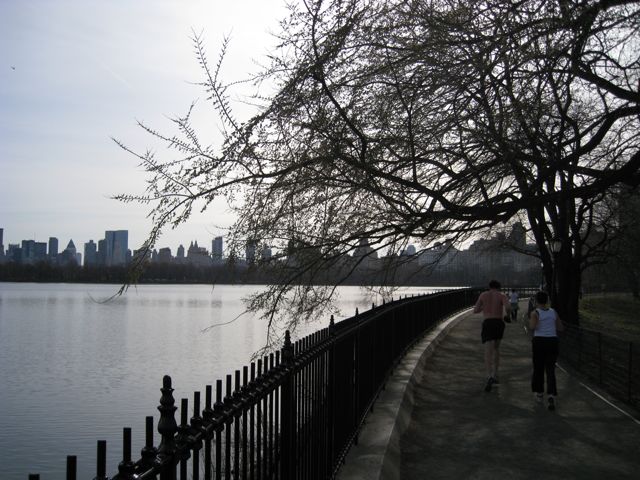
The rest of our day was taken up with the learning journey to Central Park and dinner with Buddy Hoffman and the gang from Grace Fellowship. We returned to Gotham Hall in time to hear the Fray play a concert and head home for the night. Hard to believe there is only one more session left!
Chelsea Art Tour Learning Journey
I’ve said over and over that the value of Q has been the people attending. Several of the attendees are fellow bloggers. One of those is Jenni Catron, who I met in person for the first time this week. Jenni and I were on different learning journeys, so we decided to trade experiences! Here is her guest post. And if you have a chance, go check out her blog here, where you can read about my learning journey at Q! I will be writing a guest post on her blog about my trip to Central Park.
One of the things I have loved about Q is the opportunity to network with
others. Marla had the brilliant idea that we guest blog on each others
sites about one of our Q experiences, so here is an overview of my learning
journey today. Thanks Marla for the opportunity to speak to your audience!
I signed up for the Chelsea Art Tour not really knowing exactly what it
would be like. I am totally unfamiliar with art, so I thought this might
open me up to another dimension of creativity that I have not really
explored. Well, things did not get off to a great start. After gathering
with our group in Gotham Hall, we headed out on 7th Avenue and were going to
walk to Chelsea, about 15 blocks away. Within the first block, about 8 of
us got separated from the group and couldn’t find them anywhere. We spent
the next 45 minutes trying to catch up with them to no avail. Finally
someone tracked down the tour guide’s phone number from her website that he
found on his iphone. At this point the rest of the group was halfway
through the tour, but we jumped in anyway. We visited four galleries:
– Dillon on 25th St. featured a couple of pieces by Makoto Fujimura, a
painter whose work explores a combination of contemporary American abstract
expressionism and traditional Japanese art of Nihonga. Makoto also spoke in
our evening session of the conference and was very inspiring.
– Luhring Augustine on 24th St. featured the work of Gregory Crewdson. His
art is staged photography and was really intriguing. The highlight of this
stop was when I realized Ben Stiller was standing next to me looking at one
of the photographs!
– The Andrea Rosen Gallery featured a collection from Katy Moran. I could
see some of her paintings in my own home. Very pretty, soft colors.
– Zach Feuer Gallery featured the video art of Tamy Ben-Tor. This stuff was
just bizarre. It looked like something that someone would put on YouTube as
a joke. I’m not sure what makes this gallery worthy, but it intrigued me
enough that I’ll probably try to find out.
Ultimately I think this learning journey did what it was intended to do. It
opened me up to another area of culture that I have never really explored
and I feel more educated because of it.
— Jenni Catron
Q Day 2
Day Two has started with a bang. It was an early morning, but even I think it was worth it!
Louie Giglio started us out with a reminder, as culture shapers, to honor the past while moving forward with the church. I loved his illustration. In Hong Kong, designers retained three ancient trees and an ancient house while building a skyscraper around it. He also talked about Chris Tomlin rewriting Amazing Grace. My chains are gone, I’ve been set free…Honoring the past while moving to the future.
Next up was Jamie Tworkowski, from To Write Love on Her Arms. If you aren’t familiar with his movement, check it out on the internet. I loved his thought that we are meant to live in community, and it is that deep interaction with other people that brings healing and health.
Jim Wallis, social activist, was next up with a reminder that successful social movements have spiritual foundations at their heart. He wrote the book “The Great Awakening,” which examines major revivals and their societal impact.
Finally, Michael Luo, a reporter for the New York Times, entertained us and educated us about the reality of life in the media and the media cycle. A believer working at the New York Times? Now that was worth coming for. Favorite quote of the morning came from him. Gabe Lyon asked him whether he thought faith should be a litmus test for candidates. With a smirk on his face he replied, “I don’t have opinions.”
By the way, the weather here in NYC is in the upper 60’s and beautiful. Trees are budding, flowers are blooming. David and I are sitting in a Starbucks located inside Macy’s overlooking the perfume floor (ie: Serendipity, Elf, every other New York Movie). This is a great coffee shop!
Q Evening Sessions

Day one at the Q conference has drawn to a close, and I am exhausted! But what an interesting stretching day we had. Some highlights from the late afternoon/evening sessions:
During a 3 minute session Scott Harrison spoke about his brainchild, Charity:. Charity: is not an overtly Christian organization, but it is dedicated to raising money to drill clear water wells in developing countries that have no good drinking water. This guy has just been faithful in doing seemingly small projects. But along the way, his small projects were noticed by people with big connections. For instance, he had a 2 minute spot air on American Idol tonight. How cool is that? I’m challenged to help by doing the small things.
Andy Crouch spoke about why we can’t change the world. It was a great reminder that God is the one who changes the world, not us. We just get to join him where he is at work. When God changes the world, it often takes time, happens in out-of-the-way places, and gives power to the powerless. What a relief to realize that we don’t have to shoulder the burdens of the world, just be faithful to our relationship with Christ. Culture — and the world — belong to God.
After our dinner break we had a great time of worship before Tim Keller got up to speak. He spoke on the call of the city on our lives. As the highest density of people per square mile, the city is ripe for God’s work. Keller passionately believes in his mission to the city, and he is passionate about everyone else understanding the opportunities and challenges posed by the city as well. By the way, a city is defined for his purposes as a mixed-use walkable human settlement exhibiting density and diversity. Size is not the defining characteristic. Tim Keller’s talk was challenging, especially at the end of a long day.
We closed our day by meeting Greg Reade, a worship leader for Student Ministries at Christ Fellowship, for dessert at a great restaurant. Not a bad start! Tomorrow we get new table assignments, meet new people and go on our field trips.
By the way, the illustration at the top of the blog was drawn real-time by a “scribe artist.” I loved the way he captures the essence of a talk in a sheet of paper. In case you can not read this one, it is about Charles Colson’s talk.
Afternoon Q session
Chuck Colson lead out the speakers with a great reminder that God has given us a cultural commission to transform our culture for the kingdom. He reminded us to do this in a winsome, loving way.
Leroy Barber spoke very eloquently about Martin Luther King’s beloved community, and how that should look in the world. One of his points really struck me. In the early church climate of RADICAL Christianity, one of the ways this faith was worked out was by eating together in their homes. There is a theme near and dear to my heart! Imagine: inviting people into your home is a radical, transformational act. It makes me want to go home and be more intentional about the diversity of who we bring home in addition to the usual cast of characters.
Finally, Eboo Patel (Interfaith Youth Corp) spoke about Christians and Muslims working together for good. “We may have different perspectives about eternity, but we share the same view of earth” Given all the thought David and I have put into the Muslim outreaches, we were really impressed with Eboo’s presentation.
Right now there is a panel of three guys who are discussing their outreaches and how their faith lives in the world. Socrates in the City…great name.
