Phil’s Armor

I sat in a meeting yesterday with Phil. I have known Phil and his wife for years. We’ve spent time in worship together, eaten at social events together and — memorably — served side by side on a committee of leaders committed to living life together in community. Most recently, David and I have been with Phil in a group of people learning about generosity together. So you know who Phil is: he’s the guy you know from church. You know him this well, but no more. He could be sitting in the next row from you in church this week, too. He is, in many ways, a church everyman.
Well yesterday, as I said, we were in a meeting on generosity with Phil. It was one of those meetings that could go either way. You might end up baring your soul or you might end up creating a church-wide action plan. Or you could, conceivably, end up wishing you’d kept your dentist appointment instead of attending this meeting. Now you know the kind of meeting we were in with Phil. Perfectly unremarkable.
Until Phil began talking.
He told a story about the whole armor of God. And forget the tacky Roman sword and breastplate…Phil related that passage of scripture to the gear he used during his time in Vietnam. It was a time in his life where that helmet of truth — the helmet — was more than a theory to Phil. No helmet, no head. Simple. That belt and breastplate and sword, they were the tools that kept Phil alive. He told us about a buddy, standing next to him, who was dead in an instant. With a tongue that dripped vocabulary like KIA and MIA and WIA without hesitation, Phil reminded us that living in the kingdom is living in a war zone. And maybe, just maybe, some of us are standing around without our helmets on.
Phil has a great story, and I never would have known it if I didn’t sit still long enough to hear it. And his background colors and influences everything he does. For Phil, our study in generosity means something completely different because of his experiences. It’s richer, or at least different, from mine.
I was convicted yesterday, wondering how many unique and inspiring stories like Phil’s are sitting next to me in church or the coffee shop. And I’m wondering how to tell them.
Transformation, The Nines, and Consequential Strangers

Set your foot on the path of walking through Christ’s kingdom and watch the adventures that result. I dare you. Try it. No sooner do you set your purpose towards living an incarnational, tangible representation of grace in the kingdom than along come trials ready to knock you off the path. It is certain, and it is healthy. Who knew that God would take me at my word when I said “Whatever you want, Lord…it’s your kingdom!”?
Yesterday I spent a large chunk of my day watching The Nines, an online video conference. Teachers and friends from all over the country had nine minutes of video time to share the message that was in their heart. The day, as a whole, was a little bit like drowning in an ocean of ideas. If you missed it, I’ve heard the videos will be online. When I find that link I’ll share it.
In the meantime, I was hit by an idea shared by Pete Wilson, pastor of Crosspoint in Nashville and one of my favorite bloggers. The real issue facing the church today, said Pete, is not that people aren’t coming to church, but that they aren’t being transformed. We need to teach people HOW to live out this kingdom life. So true. And one component of a transformation, according to Pete, is learning the rhythms of Christ’s life. It is a balanced rhythm of solitary learning and community. It was only a small point of Pete’s talk, but it rang a bell with me. Community impacts our spiritual life in ways we cannot anticipate. To cut ourselves off from community is to cripple our attempt to live a balanced life.
At the same time I have been reading a book called “Consequential Strangers: The power of people who don’t seem to matter…but really do.” by Melinda Blau and Karen L. Fingerman. The gist of the book is that the web of acquaintances and near-strangers in our lives (dry cleaner’s, barista’s, person you see at the gym) offer a security and richness to your life. The more of these consequential strangers you have in your life, the more likely you are to encounter a new idea, an idea that can transform your life.
Which brings me right back to transformation. Seeing the consequential strangers as resources and gifts placed in my life has changed how I view casual encounters. Although I always knew it, I’m much more likely now to look for God’s purpose in even the small epidsodes of my day. Today alone a short conversation with a barista I barely know has caused me to rethink an entire ministry strategy, and I can see that a loosely connected web of near strangers is going to impact someone’s life deeply for the kingdom.
On a personal level, I can feel a convergence of information from The Nines, information from Consequential Strangers, ministry situations and personal spiritual rhythms. Walking through this life I’ve learned not to ignore those perfect storms of learning: God always has a purpose in them. I honestly don’t know if this terrifies me or brings me joy — or both — but I feel it coming. Time to hold on for the ride.
The Nines: the best of what technology can do!

Tomorrow I am inviting you to participate in some of the best technology you will find on the internet. So many times we hear about what is “wrong” with the internet, with social media, with the new digital society. Tomorrow we will see what is RIGHT about all those things.
I am talking about “The Nines,” an online conference happening over the internet tomorrow. Over the course of the day tomorrow, this FREE (Yes, Free!) conference will present 70 of our country’s top Christian leaders. They will each speak for 9 minutes, up close and personal. Imagine 9 minutes with top pastors, worship leaders, executive pastors, authors. I’d give you the names of the speakers and you would recognize some of my personal favorites such as Steven Furtick and Mark Batterson. But any list I give you will be incomplete. Go to the website and look at who is going to share tomorrow. Then register for the event, because while it is free, you have to pre-register.
And I suppose it goes without saying that there will probably be multiple posts, twitters and new ideas coming your way from me tomorrow! Make it a two way street…go sign up and get in the conversation.
A Generous Life

I was challenged today to think about what it means to live a generous life. Now since I heard this challenge in the midst of a coaching session on generous giving, I was tempted to think in financial terms and move on from there. But the phrase “generous life” keeps coming back to haunt me.
Let’s discuss financial terms for a moment. We’ve all known people who — whether by need or by personality — are not generous with their money, whatever level they live at. I’ve known friends who didn’t have two nickels to rub together and yet would share or give anything they have. I’ve also known wealthy people who are willing to write large checks to certain organizations, but will give not a cent more to an employee or a service professional. These are perhaps all typified in Dicken’s Christmas Carol. But most of us live somewhere in the middle of these extremes. And I’ve known people, as have you, whose focus on protecting their money, calculating their fair share, has made them difficult friends to have around. They live small-minded lives when it comes to their money, forgetting how big their God really is.
Our lives are a little like that, too. We can be small-minded and miserly with our lives.
I don’t want to be miserly. I want to live large and open handed, being a free conduit of all the blessings God has heaped on me. But there are areas of my life where I realize I’ve been calculating a 15% tip and not wanting to go beyond. There are areas where my desires seem of paramount importance to me, and I’m having a hard time letting go of that, quite honestly. Want examples? My 16 year old daughter decided to clean out my pantry, throwing out the junk food, the old, the unused in five years. Since I don’t eat the junk food most of the time, it was really her own stuff she was pitching and I should have been glad for the “help.” I wasn’t. I felt like someone had turned the contents of my purse upside down and was busy tossing “junk.” A generous liver would let go of that. I am possessive of my time, my solitude, my dog (not a problem — he loves me best!). Sometimes that ability to be alone is all that saves me in my crazy, mixed-up household. I don’t let go of that easily. I don’t want to be generous with my reputation, and yet can I really control that anyway? I don’t want to be generous with my dreams. Nothing clams me up quicker than asking me what I want to write about in the future.
So there we are. It’s a rainy, stormy day when I want to close in on myself and soak my troubles away in a hot tub. But I’ve got life swirling around me, and it’s time to re-engage. It’s time to live a generous life.
My new best friend

David and I were driving through McDonald’s last night for a bottle of water. We are in Atlanta dropping Kylie off for her fall semester of college, and we always enjoy noting the cultural differences between our area of South Florida — which lives and acts a little more like the north east — and the true south represented here in Georgia. Here we find people willing to slow down, offer suggestions, hear what you have to say. And this McDonald’s struck us as the same. The girl welcoming us to McDonald’s sounded so happy, and in light of the heat was suggesting we try an iced mocha today. “No, thank you,” David politely responded. “We only need a bottle of water. But thank you!” The second drive through worker, a guy this time, gave us our totals and we obediently pulled forward.
Waiting for the worker to come and take our money, we noticed this sign: “The automatic greeter starts the moment the car pulls into the drivethru. BE READY!”
You guessed it. Our sweet, cheery friend was electronic. And she didn’t care a bit about the heat, or the iced mocha, or that we were only requesting a bottle of water. She was an illusion of community.
I’ve thought about that a lot today. What does fake community look like? Do we create fake community in our churches with nametags and greeters? Do we do it as we go about our errands and business by not really listening to the responses? And isn’t it a hollow, I’ve been had kind of feeling when you realize that what you thought was a person who connected to you was really just an automatic greeting?
No more life on automatic for me.
Be there!
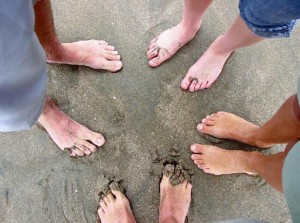
I want to be there.
Do you know what I mean? Walking through life, we can skim the surface of our days, barely registering what’s happening around us and not entering in emotionally. I don’t want to settle for that. I think the quest for building community — life-changing, open hearted community — requires that we jump in with two feet and learn to be there.
I want to be there when my community is celebrating or mourning.
I don’t want to walk through life dry eyed, and untouched.
I want to celebrate and dance, cry and mourn. I want to spend quiet moments with the people who matter. And I want to quietly be there for the big moments, that splatter our lives with the color of our future.
I want the people who matter to know it, deep inside their souls, so that we can walk through life together with faith and belonging.
It is one of those days.
And I want to be there.
The value of making something: Shop Class as Soulcraft

I read this mini review on Relevant Magazine’s online newsletter today. I thought it was interesting. There does seem to be a return to creation, making tangible things with our hands, and placing value on those who do. It’s another way of keeping life a little bit more local in the midst of our global society!
I haven’t read this book yet…it’s now on my list.
From Relevant Magazine….
7. Shop Class as Soulcraft: An Inquiry into the Value of Work, by Matthew B. Crawford
A philosopher/mechanic, Michael Crawford explores the benefits, both for the individual and for the community, of the manual trades in Shop Class as Soulcraft. Drawing on his own experience as an electrician and a motorcycle mechanic, as well as the experiences of other craftsmen he encounters, Crawford challenges the prevalent assumption that college is for everyone and articulates the difference between the “knowing how” required of the trades and the “knowing what” stressed in the modern American education system. “Practical know-how,” Crawford argues convincingly, “is always tied to the experience of a particular person. It can’t be downloaded, it can only be lived.” Shop Class as Soulcraft is an especially salient read in today’s economic environment and calls us to reconsider how good work is defined in 21st century America.
—Sara Sterley lives near Indianapolis, IN and regularly contributes book reviews to RELEVANT.
Are You Being Served?

Have you had your toes stepped on lately?
My pastor warned us that studying James was like having your toes stepped on repeatedly, and he’s right. God does that sometimes, inflicts a little bit of emotional pain (or a lot of it) to teach us a lesson.
Yesterday I was listening to the August 1 sermon by Buddy Hoffman from Grace Fellowship Church in Georgia. This church is my “second home church,” and when Buddy brings an admonition, I listen. This particular Sunday Buddy was reading a report sent in by the Mystery Worshipper for Ship of Fools website. Let me tell you, these were some tough words to hear. I admire the fact that Buddy was able to read the good, the bad and the ugly to his congregation. We heard it all. And by the time the podcast was over, a lot of toes had been stepped on.
You see, this Mystery Worshipper realized that God was at work at Grace. Anyone stepping on campus can tell that. Great things are happening, almost faster than the congregation can keep up with them. And therein lies the trouble. Everyone at Grace was so busy doing the great things, that a first time visitor felt lost and lonely in the midst of a spiritual feast. The service was amazing, he said. Loved the music. Loved the preaching. No one said hello. No one except the “official” greeter whose job it was, and the usher telling the Mystery Worshipper to change his seat of this reason or that.
So running along on the treadmill, I listened to Buddy remind us that hospitality (also known as community) is a holy work. It isn’t something we offer to those we already know and like the best. It isn’t the “if you have time, could you say hello to someone…” No, it is the above all else kind of commandment. It is holy, and it isn’t optional. Right about then my toes began to ache. Let me tell you why.
Yesterday David and I sat down to eat at one of our favorite restaurants. It was a beautiful day, and we had a seat by the intracoastal waterway where we could watch the boats drift by. We had an appetizer to share and cold iced teas. All should have been well, and it was. Until we noticed that the family sat well after us were in the process of ordering, while we still had our menus and hadn’t put our main order in yet. Even though we’d been waiting long enough to get our appetizer. Normally this kind of thing doesn’t even rise to the level of something to notice, but yesterday…well this waiter was commiting a faux pas in my book, and I needed to share that with him.
I’m sure he was delighted to learn how I felt.
Those of you who know me will know that I wasn’t even really rude (though I felt it, inside). I think I said something along the lines of “It’s just not right to take their order before ours.” The waiter apologized and spent the next half hour hovering over us. Then he heaped a few coals on my head by having the house pay for our appetizer. “We looked on the computer and you come here a lot. We want you to be happy.”
Great. I am known.
Buddy’s words about hospitality stabbed me to the heart later, as I tried to work off that very same food at the gym. “Be especially hospitable to the people out in the community,” he said. Yes, this means waiters. “It’s a holy commandment.” I know my words were not over the top to this poor waiter, but I also know what my attitude was. I was wrong. I was not putting the waiter’s life in proper perspective, assuming that he should exist solely to serve me.
I spent the rest of my workout talking to God about that waiter.
James says that community is hard to build when we are quarreling and grouchy because we want something and don’t have it. I’m limping a little bit today from the toes that have been stepped on, but it’s a good ache. It reminds me of what God wants to do in me.
Books and charity: perfect match

Some people live for the scent of pine on the air, the crisp smell of the mountains. Others crave the salty air of the beach towns. Not me. I crave the smell of books. Just walking into a good bookstore (preferably one with a coffee shop, to add in the scent of brewing beans) triggers an instinctual deep breath. It is like a spa experience. I feel looser, more calm, more truly myself when I am walking among books.
I went back to my “office” today, Barnes and Noble, as you can tell. I took a deep breath and realized what has been missing nearly all summer long. Books. Not just my books — I have plenty of those, delivered by Amazon and by Kindle to my phone — but books that encompass all of life. I love the feeling that there may be a book which will change the course of my life just on the next shelf. Sometimes, there are. Today I snatched up “The Suburban Nation” (see yesterday’s post) before I could change my mind on it once again, as well as several other interesting reads.
And then I sat in the cafe. I sat next two three twenty-somethings, one girl and two boys, earnestly discussing the new charity they are starting. The girl, apparently, is in charge of the website. The guy wearing a white T shirt was her client. And the other guy, a silent black kid who rarely spoke, apparently was the ultimate authority. Whatever he said — perhaps as a result of being so rare — carried the weight of the final decision with the other two. They made me happy, these kids. They have donors, a facility, funding. They are putting the website live in two weeks. And somehow they are making a small living off this project. In short, they are the perfect picture of my “Generation We” kids: young, interested in working for a greater cause, and doing it in new and fresh ways.
“It doesn’t matter that we’re young,” I heard the girl say. “It matters that we’re good.”
Couldn’t have said it better myself.
City planning and life planing: the Suburban Nation

I’m busy doing a little city planning in my mind today. In five minutes at the bookstore I skimmed a book called The Suburban Nation. I wish now that I’d bought it, but I didn’t, yet, so this is all based on my brief acquaintance with the work! Google it: there are lots of reviews out there. But the basic premise is this: America has a suburban sprawl creeping the nation. You know what I mean. Each town looks pretty much like the next town, with its standard assortment of recognizable restaurants and stores, and very little to distinguish it from the next town over. In some ways, we are comfortable with this trend. It provides us with known quantities in shopping, eating. In other ways, we wonder why there’s no real sense of “place” in some of these places.
The author offered severa reasons for the suburban sprawl, including several that really stood out to me as making sense in both city planning and in life planning.
- Curved streets as opposed to straight streets. Apparently a curved street is the little black dress of city planning: everyone wants them. But the curved streets also limit the sight lines of a town. You can’t look down the square and see the courthouse at one end and the church at the other. This creates a lack of landmarks, and a blandness in character. In addition, modern planning has us treating churches and other civic buildings the same way we treat our residences. We hide them behind an access road and lots of landscaping, rather than embracing the role they play in our lives.
- Failure to appreciate our public spaces. we have lost the concept of the public space, except (as the author says) in Walt Disney World parks and in shopping malls. In days gone by we valued — and budgeted for — public places for conversation, leisure, gathering. And while we have the rise of third spaces (something I’m all for!), something is lost in the translation.
- Lack of meaningful destinations. If a person were so inclined to leave their home and walk, in most suburbs there is no meaningful destination to walk to. In an ordinary amount of walking time, the person will only arrive at more manicured lawns and homes. Small towns and cities that thrive — Such as the author’s example of Alexandria — offer basic services and entertainment within a five to ten minute walk.
There was more, so much more, but these issues really spoke ot me on a spiritual level, as well. Life is kind of like that city planning. We really need to honor what is unique about our own lives and the lives of others. Sometimes the straight path leads to a greater appreciation of what lies on the other end. I know I need to stop and enjoy how far I’ve come, how the view from here could not have been imagined from there. We also need to build public spaces into our lives. The blessings God has heaped on us are not for our enjoyment alone. All of the beauty and wonder of life multiplies when it is shared. Grief is more bearable, joy is more vivid. God has meant us to live in the public square. And finally, those meaningful destinations call. Setting a compelling vision for your life and celebrating the goals along the way are what make us unique from each other, distinct, with character. I want to make sure that my days pass journeying towards a meaningful destination, not wandering in a circle mired in errands and minutia.
Just a few odd thoughts at the end of a very busy, productive day. And yes, I’m headed back to the bookstore as soon as possible!
