Are you a regular?

It’s all about people.
I think that might be my mission statement in life. I am passionate about connecting with people, whether in the community, the church, or online! One person I have connected with — and adore — is Jenni Catron. As brand new bloggers last year, we managed to find each other as we both began talking about an upcoming conference we were both going to attend. Then, at Q (some of the most transformational days I’ve ever experienced), we met face to face. Jenni and I have slowly been building a cyber friendship that once in awhile spills over into the real world, like at Catalyst 08 or when David and I stopped in to visit her church in Nashville. Yesterday Jenni wrote this post on being a “regular,” and I immediately asked to reprint it here. It captures a lot of my heart…and hers.
“I Love Being a Regular”
Every Tuesday morning Pete and I have our weekly meeting at the same restaurant. This has been our routine for well over 2 years, so it’s safe to say we’ve become “regulars”.
Here’s why I like being “a regular”:
- Everybody knows my name… I know you’re singing the song from Cheers right about now, but it’s really true.
- I’m comfortable. I can relax because I know what to expect.
- I order “the usual” and the wait staff know what “the usual” is for me. (In case you are curious, it’s a bowl of oatmeal with fresh strawberries and brown sugar and of course a cup of English Breakfast tea.)
- I know the other regulars and they know me. There is a fun cast of characters that share our usual Tuesday morning routine… we’ve developed our own little community.
Why does this matter so much to me?
Belonging. I feel like I belong. I have a place. There are people who know me and miss me when I’m not there.
It’s amazing how such a core need can manifest itself in something as simple as where I eat breakfast.
It makes me wonder what I can do to help the people around me become “regulars”? What can I do to help my staff feel that they belong? That they contribute? That they are needed? That they are valued?
Being “a regular” gives me a glimpse of the power of community. It’s the unique connection that we share as humans to love, appreciate and encourage one another.
So, who in your life do you need to make feel like “a regular”?
Catalyst 08 and related: Aaron Keyes on worship

Aaron Keyes electrified Catalyst with his worship set this month. Every time I hear him I am blown away by his grasp of scripture and his heart for true worship. This past Sunday he spoke on his vision of praise and worship at his home church, Grace Fellowship in Snellville, Georgia. The video below is the full sermon — 40 minutes plus or minus. Here are Aaron Keye’s top eleven reasons why we should worship God. I loved this. Honestly, the full sermon is worth listening to. For instance, he talked about the distinction between Praise — vertical directing of our praise to God — and Worship — falling on our face before a holy, awe-inspiring God.
Why We Should Worship God
1. He commands it. Psalm 150
2. He is present and enthroned in our praise. Psalm 22:3
3. There is great power in our worship and praise: Power for spiritual warfare (psalm 149:6), Protection from attrition (flesh), Becoming more like Jesus (Psalm 115), Releasing the full work of God.
4. It’s a good thing to do – pleasant and fitting.
5. He is worthy of it.
6. It’s partly why we were saved in the first place – saved that we may declare his praises.
7. Worship gets my mind off of myself. We become enthralled with God.
8. Worship cultivates unity and oneness. When the unity goes up, the glory comes down.
9. Worship produces a spirit of gratitude within me.
10. It is why I was saved, why I exist.
The best reason to worship:
11. We can give to the Lord something that delights him. We can delight the heart of God. He will cherish it forever.
Chasing away the monsters in the dark

I am not afraid.
I never have been very afraid. I grew up with a daddy who cares for me, friends who love me, and innate — if often unfounded — optimism. So fear and I usually don’t hang out much. I’ve always thought that was a good thing, a gift.
Until I read something Leroy Barber wrote in New Neighbor today. He talked about being afraid of non-existent monsters in the dark…no reason to fear them. (Yes! See? I knew there were no monsters!)
But some monsters are real. He lives with them. They are the monsters of poverty, poor education, abuse, loneliness. Like all monsters, they flee in the face of the light. But they dwell in darkness. If there are real monsters in the darkness, happily laying our heads down on the pillow and drifting off to sweet dreams is not the right response. It is not rational.
Neither is fear.
The clarion call to our generation — my generation — is to hold up the flashlight and begin to chase those monsters away. The next generation is superb at this. They are embracing justice issues right and left. If there was one thing I learned from Catalyst it is that my generation must empower the next generation to risk big, monster-chasing dreams.
This is part of Watercooler Wednesday! Gotta love Wednesdays.
Catalyst 08: The moments you live for
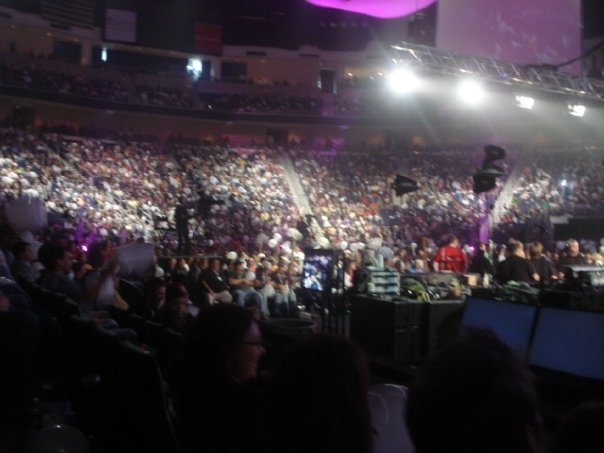

As the days have passed since Catalyst, the experience is distilling in my mind down to those moments of clarity when God steps into the picture and creates something unexpected and new. There were a few events that — for me — are weaving themselves into the takeaway message that God wants me to have from the week, so I thought I would share them with you.
- Worship. Everyone who goes to Catalyst surely comments on the worship. Steve Fee did a great job with his sessions, and I enjoyed hearing his worship sets and joining in. There is something electric in joining with thousands upon thousands. But for me, there was one set that sent the tears creeping out of the corner of my eyes: Aaron Keyes led us all in moments of unselfconscious, soul-stretching worship. During one moment he stepped back from the mic and let 12,400 people lift their voices together. It is awe-inspiring.
- Michelle. Michelle was an attractive girl who was interviewed onstage between sets. She was in her twenties (perhaps?) and was there as a grown up Compassion International child. She told her simple story of how the sponsorship through Compassion changed her life. Eventually she was sponsored through their leadership development program, as well, and was able to come to the States for an education. I am sorry that some of the details of her life are escaping me, but this grad student (who I believe is leading an arts troupe as well) sponsors three Compassion children of her own. She finances this by cutting her meal plan ticket at school from 20 meals a week to 10 meals. It was a moment of conviction and delight to see the fruit of such a simple thing as sponsoring a child.
- I cried during Steven Furtick’s message, too. The hand of God is just all over this guy, and I have hope for the next generation. I was moved to pray over his life, his family, his calling: pray that God will hold him faithful and fulfill the promise he represents. I was touched during his session when he asked the original seven families who started Elevation with him to stand and receive recognition for their faithfulness. People — community — are everything.
- The ministry tables set up outside the conference. There were amazing experiences designed for us out there. Not only could we participate in activities (“That was simple…you mean that helped?”), we could see others giving their lives away for justice and compassion.
There were other moments that I hope to process in the days to come. And there is the big question still to come for all of us who were there: “So?”
What about you all? Where did God show up for you? And what’s next?
Catalyst 08: Andy Stanley Closing Session
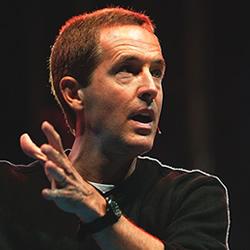
Good things come to those who wait. Or stay. Andy Stanley closed out Catalyst 08 with an amazing reflection of where he and his staff at Northpoint are in their thinking process. He gave us five quotes that he grapples with on a daily basis. The thought processes inspired by these quotes are driving the next steps of Northpoint, Buckhead etc. David and I found a lot to think about in this session, and that process has just begun. Here are the five quotes and thoughts that Andy Stanley and his staff are working through.
“To reach people no one else is reaching, we must do things no one else is doing.”
— Craig Groeschel
- There are people who will never step through the doors of our churches, no matter how cool our churches are. How will we reach them? We have to think of brand new ways of going to them, even if “traditional church people” don’t necessarily like them. In response to this quote, Northpoint has tried several projects: Buckhead Music Project, a new Northpoint Spanish service, Google Ads, Letters to the Next President. These are just the first fruits of thinking deeply about questions that bother you.
- Some people won’t donate more money for church operational costs, but they will donate money to try something radically new to reach people no one has reached.
Takeaway: Become preoccupied with who you haven’t reached as opposed to those you want to keep.
“The next generation product almost never comes from the previous generation.”
— Focus, Al Reis
- If you are 45 or older, the next great idea most likely won’t come from you. Your job, instead, is to constantly seek out the next generation and hear what they are thinking. Enable their visions to come true. Go look to the 20 year olds. If you want to find examples of radically different thinking, you should be paying attention to what your Student Ministries guys are talking about.
- Don’t do to the next generation what was done to yours. Don’t say, “We don’t do things like that.” Stop and think about what they are proposing. Give them space, money, social capital and the freedom to fail.
Takeaway: Be a student, not a critic
“What do I believe is impossible to do in my field…but if it could be done would fundamentally change my business?”
— Future Edge/The Paradigm Book, Joel Barker
- One of the stickiest problems in the previous generation of church leadership and growth was requiring a great leader to also be a great communicator. Those are two skills, and not that many people have both. What if a church leader didn’t have to beat the brunt of communicating?
- The leader/communicator issue was solved by the multi-site video venue. Now a teaching pastor can communicate well, while each campus can be led by a great leader. This fundamentally changed church growth.
- A current sticky problem to ponder: church plants need space, while some older churches are underutilizing their real estate. How do you bring those together?
Takeaway: Pay attention to people who are breaking the rules.
“If we got kicked out and the board brought in a new CEO, what would he do? Why shouldn’t we walk out the door, come back in, and do it ourselves?”
— Only the Paranoid Survive, Andy Grove
- The first thing an outsider might say about your organization is “Why in the world are you doing that?” We fall in love with the way we do things and forget to constantly reevaluate. The fact of life is that usually without pain, there is no pain. And usually that pain is financial.
- Where are we manufacturing energy? These are the programs that we do because we do. We aren’t all that excited about them, but it is what we do. We just manufacture energy. Get rid of them.
- It is painful to change. Yes, your context makes it difficult to get rid of this program, or that. It is difficult everywhere. It always hurts.
Takeaway: Acknowledge what’s not working, and own up to why you are to do anything about it.
“When your memories exceed your dreams, the end is near.”
— Michael Hammer
- We don’t want to be an expert on the previous generation!
- Celebrate the past, yes, but don’t be so celebratory that you forget the future.
- Are you willing to be invested in the future?
- Complacency breeds failure.
Takeaway: Don’t let success overshadow your vision.
Andy wrapped up by saying that in these very turbulent times it will take courageous leadership to leverage the situation in this country. Yes, people turn to God when times are difficult. Are we ready for them to do that? The fundamental problem in this country is not financial or political, it is a heart issue. It is time to step up and lead. Lead with whatever gift God has given you. Now is the time to be bold in your leadership. Be bold in your gift. Now go out and lead.
Catalyst 08: Matt Chandler

When thinking about Catalyst ahead of time, another priority speaker for me was Matt Chandler. I have heard podcast messages from him, and was anxious to see him in person. I found that watching him is an interactive adventure. He moves a lot, he is a great storyteller, and his physical mannerisms tell a large portion of his message. As a result, while I enjoyed his session immensely, my notes are pretty sparse! For instance, he led off with telling a story about a baptism at his church (The Village Church in Highland Village, TX) in which they baptized a witch, an atheist and a baptist. And yes, it sounded like the set-up to a joke. Except it wasn’t. It was a slice of life in his ministry. Chandler went on to speak about how the Baptist kid had known about Jesus, but hadn’t ever really known Jesus himself. Using I Timothy 4, he reminded us to keep watch on the way we live, because there is a way to live that exposes people to Jesus or turns them away from him.
“The good new of the gospel is that you get jesus…and he is all you need.”
Catalyst 08: Andy Crouch

Andy Crouch spoke on culture making, the subject of his new book Culture Making: rediscovering our creative calling. I have that book on my stack of “next-ups,” so was anxious to hear his talk. Here are a few points:
- The twentieth century has moved from condemning culture to critiquing culture to copy culture to consuming culture. Each of those stages has, obviously, different impacts on the church and our contribution (or lack thereof) to culture.
- We need to move to cultivating culture. We need to keep what’s good in our culture, good.
- We are also called to create culture. The things we create stretch into eternity. He made the point that the Bible says that in the New Jerusalem the people will bring in the glory and honor of the nations. In other words, the good things that we have created. So creation is a worthwhile pursuit, a divine pursuit.
- Cultivating and creating is hard — much harder than the previous condemning, critiquing and consuming — but cultures only change when you create more of it, add to it.
- Culture can only be created together. Very rarely has anyone created anything significant totally alone.
- The best size community for creating seems to be three. This is the ideal size to believe that “all things are possible.” Three people can enter into the suspension of impossibility that is needed to create something new.
- After the creation, you need a group of 12 to bring depth to the creation. They will add into the new creation aspects that the 3 perhaps did not think about.
- Then you need a group of 120 to bring breadth to the movement. This is what starts to spread the culture, help it go viral.
- Finally, we are to celebrate creativity wherever it is found.
Catalyst 08: Franklin Graham and Billy Graham

A highlight of the day, in a very different way, was the presentation of the Catalyst Lifetime Achievement Award to Billy Graham. It’s hard to overstate the impact Billy Graham has made on our world: any words you use to describe his incredible ministry still fall far short of the reality. They showed a retrospective video of Graham’s ministry and then his son, Franklin Graham, came up to accept the award on behalf of his father. Andy Stanley, in presenting the award, made a statement that caught my attention. “Because of the internet and technology,” he said, “It is unlikely that any other person will ever speak in front of as large a live audience presenting the gospel again in the history of the earth.” Wow. Well done, Reverent Graham.
Franklin’s session detailed his Samaritan’s Purse ministry and the various ways God has used them. A touching moment came when Leila (not sure of spelling…it wasn’t given to us) came up to thank him for the shoebox Samaritan’s Purse had given her while she was a refugee from Bosnia in 1993. Because of that simple gift she found Jesus and a new life. Now she coordinates sending hundreds of thousands of boxes all over the world. We all had shoe boxes under our seat, and Samaritan’s Purse had a tent set up for us to stuff the boxes with goodies and include a note to the recipient.
A couple of interesting points from Franklin Graham’s message:
- We aren’t here o have a good time. That’s not why we are on this earth. We are here to bring glory to God. So figure out how you are going to do that.
- There is real, literal power in the gospel message of Jesus Christ. Don’t underestimate the message.
- When you invite someone into a relationship with Christ, it isn’t your invitation, it’s Christ’s. You can relax and let God do with it what he will.
- All I have done is to find out what God had for my life, then do it to the best of my ability.
In this postmodern age, it was a good reminder that God has worked down through history in every age. Now, on the brink of this transition, He works through all the worldviews because it is — after all — His world. Franklin closed with a story from the Billy Graham Evangelistic Association, which he now runs. With a surplus of cash from his father’s lifetime ministry, Graham decided on a worldwide television campaign. They trained counselors all over the world, and then invited them to bring people into their homes to watch the message on television with them. The hosts were then prepared to lead people into relationship with Christ at the end. In India alone they had 800,000 homes open for this campaign. While Graham did not feel he should give out the final number of people who entered into that relationship, he did say that nearly ever home had at least one person in it. Wow again. Well done.
Finally, we have an opportunity! The Reverend Billy Graham turns 90 this year. If you or one of those near to you had their life impacted by this amazing man, they have set up a website to send a birthday greeting and message to him. Franklin even said you will get a response back.
Happy Birthday, Reverend Graham!
Catalyst 08: Daraja Children’s Choir of Africa and Jeff Foxworthy

I haven’t been blogging the activities that happen between main sessions at Catalyst, though I hope to get around to them to some degree. But today the Daraja Children’s Choir of Africa came to lead us in worship. I’m sure most of you have seen an African children’s choir. They are energetic, their faces shine, and they make us stop and think. Today I had tears streaming down my face just watching these kids. They didn’t sing to us, they worshipped with us, and that made all the difference.
Lanny Donoho and Jeff Foxworthy teamed up to showcase these kids and the 410 Bridge. The 410 Bridge is an organization dedicated to making a difference in Kenya, the home country of these children. While both Lanny and Jeff are normally associated with laughter, today they were more about tears and prayers. Jeff had a section of his journal read about his recent trip to Kenya, and then the kids sang one last song for us.
I’m an unapologetic Jeff Foxworthy fan, and today it was my privilige to worship with him, pray for the same cause, and cry the same tears. He and Lanny were hosting a Night for Africa benefit tonight, which I wished that I could attend. If you have a minute, go over to the 410 Bridge website and learn more about this organization.
Catalyst 08: Dave Ramsey
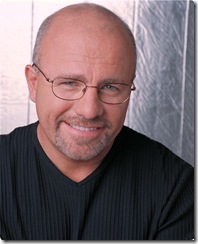
Dave Ramsey has been one busy man lately. He has been on television non-stop trying to speak peace and calm into the turbulent financial situation. Although this wasn’t the topic of his session, he is not predicting the end of the financial world, by the way.
Dave spoke about the enemies of unity, using the Tower of Babel as his biblical passage. In the days of Babel God said that there was nothing the people could not accomplish if they were of one mind. In this case, they wanted to accomplish an evil thing (the tower)…but the point is that united they truly could accompish outstanding things. And so can we, if we are intentional and proactive about creating unity. The flip side is also true: without unity, very little can be accomplished.
Dave then went on to discuss five common enemies of unity:
- Poor communication:
- Gossip
- Unresolved disagreements
- Lack of shared purpose
- Sanctioned incompetence
Dave Ramsey’s definition of gossip: when a negative situation is discussed with someone who has no power to help the situation.
